All eyes on $ANT
Summary
Anthropic’s IPO filing puts hard numbers behind Claude’s rapid adoption: first-half revenue of $16.3 billion, a growing consumption-based business and Q2 operating profit. We examine the revenue mix, the accounting charges behind its GAAP net loss, and the terms of its Google and SpaceX.AI compute agreements. The analysis also covers Claude’s role in Anthropic’s own development, the Public Benefit Fund, and the financing, safety and valuation questions investors face ahead of the proposed ANT listing.
Co-founder and CEO of Bandpey GmbH
Finally, it’s happening. Yesterday Anthropic filed its S-1 and plans to list on Nasdaq as ANT.
I went through the filing. The revenue is extraordinary. The infrastructure bill deserves equal attention. And I appreciate how directly Anthropic describes the risks attached to both.
$16.3 billion, with customers paying for usage
Anthropic generated $16.286 billion in revenue during the first half of 2026, versus $1.163 billion a year earlier. That’s 14 times the revenue. Q2 alone contributed $11.555 billion, up from $4.731 billion in Q1. These are revenues for completed periods, rather than annualised run-rate projections. S-1, pp. 148, 158.
The revenue mix is quite interesting. Consumption-based contracts produced $13.064 billion, or 80.2% of first-half revenue. Subscriptions contributed $3.222 billion. Customers pay for a substantial amount of work through usage-based arrangements, so Anthropic’s growth depends on how much those customers keep doing with Claude. S-1, Note 2, p. F-27.
About 48% of first-half revenue came through cloud-provider marketplaces. Those partners help distribute Claude while Anthropic also buys infrastructure from them. That gives investors a reason to study the commercial relationships alongside the growth figures. S-1, p. 57.
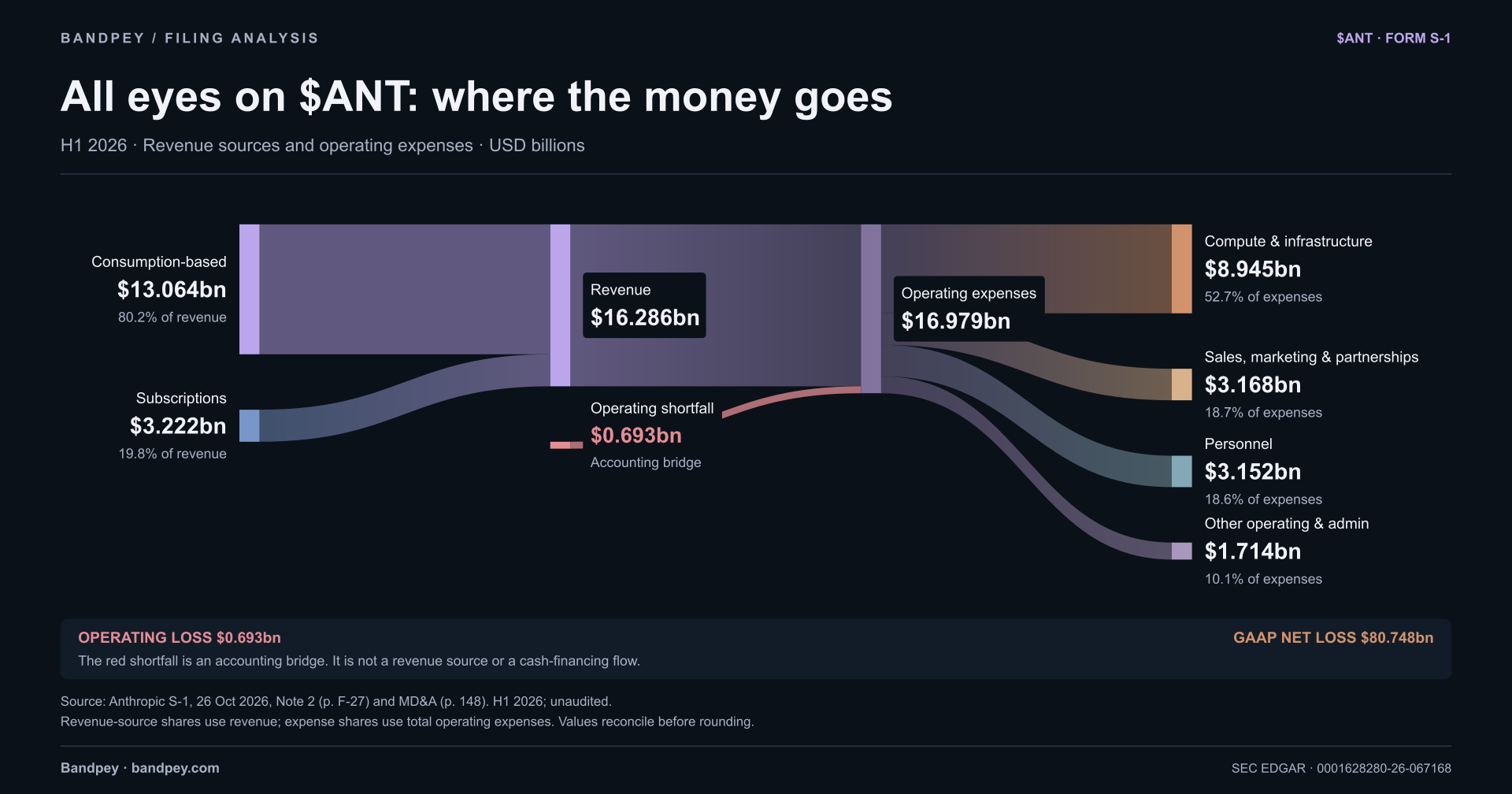
All eyes on $ANT: where the money goes
H1 2026 · Revenue sources and operating expenses · USD billions
Across that half-year, Anthropic incurred $16.979 billion in operating expenses, leaving a $693 million operating loss. Compute and infrastructure accounted for $8.945 billion. Sales, marketing and partnerships cost $3.168 billion; personnel cost $3.152 billion; other operating and administrative expenses added $1.714 billion.
Anthropic only discloses the consumption/subscription split for that period. It doesn’t disclose the corresponding Q2 split.
Q2 shows why investors are paying attention
In Q2, Anthropic earned $974 million in operating income on $11.555 billion of revenue: an 8.4% operating margin. That’s a meaningful change from Q1’s $1.667 billion operating loss. S-1, p. 158.
Revenue also grew faster than compute expense. In Q1 2025, Anthropic recognised about $0.40 of revenue for each dollar of compute and infrastructure expense. By Q2 2026, that ratio reached $2.08, an improvement of 5.22 times using the unrounded figures.
Revenue outpaced compute expense
Q1 2025–Q2 2026 · quarterly reported revenue and compute / infrastructure expense
I find that encouraging. Anthropic is generating more revenue relative to its recognised compute expense as it scales. That expense includes research, model development, customer workloads and internal use. We can’t read this ratio as gross margin, hardware efficiency or the return on infrastructure it hasn’t received yet. S-1, p. 146.
Q2 also carried a $66.309 billion GAAP net loss. A $59.597 billion fair-value charge on convertible notes, derivative liabilities and SAFEs explains most of the gap between operating profit and the net result. Investors need to distinguish that accounting remeasurement from cash spent running the company. For the first half, GAAP net losses totalled $80.748 billion. S-1, pp. 148, 158.
The compute bill comes with different obligations
Google’s agreements require at least approximately $114.5 billion between April 2026 and July 2033, regardless of actual usage, subject to the contractual adjustments and exceptions. Those agreements are generally noncancelable except for an uncured material breach by Google. S-1, p. 171.
The SpaceX.AI agreements cover up to $120.5 billion through 2029 for NVIDIA-powered compute. Once the full capacity arrives, expected in December 2026, Anthropic anticipates payments of about $3.1 billion a month. It can cancel on 90 days’ notice after initial noncancelable periods end in January and March 2027. S-1, p. 172.
Compute commitments, with the terms attached
Google: a minimum obligation. SpaceX.AI: an up-to amount with cancellation rights.
Those differences matter when assessing the exposure. Google’s minimum and SpaceX.AI’s cancelable ceiling cover different periods. Adding them into one unconditional spending commitment would exaggerate what the contracts require.
Anthropic also estimates another $125–150 billion for additional TPU capacity from providers including Google, with delivery during 2028–2031 and payments dependent on deployment conditions. That estimate sits outside the two agreements above. S-1, p. 171.
Claude writing Claude’s future
The disclosure I keep coming back to: Claude wrote over 90% of contributions to Anthropic’s codebase in September 2026. S-1, p. 137.
For me, that is evidence of how revolutionary this technology has become. The people building Claude rely on it to build their own software. Code volume alone can’t establish quality or productivity, but that level of internal adoption helps explain my enthusiasm. Developers, researchers and engineers now have a tool that can take on substantial work inside their daily workflows.
I appreciate the candour
Anthropic expects its revenue growth rate to decline over time. Management believes existing resources can cover at least the next 12 months, while warning that faster investment or changing circumstances could force it to seek financing sooner. It also describes catastrophic and existential risks from advanced AI without adequate safeguards. I appreciate seeing those concerns stated in a document asking investors for money. S-1, pp. 47, 63, 163.
At June 30, Anthropic held $112.4 billion in cash and cash equivalents, plus $19.3 billion in short-term investments. Management has substantial resources, and it is signing obligations that extend years beyond the next fundraising round. S-1, p. 162.
Anthropic has also contributed nonvoting shares representing 5% of its fully diluted June 30 share count, assuming Amazon’s notes convert, to its Public Benefit Fund. The fund is a wholly owned LLC. I like the commitment; its eventual impact will depend on governance and how it deploys that value. S-1, pp. 13, 144–145.
Reports have floated a $100 billion raise, valuations of $1.5–2 trillion and a listing in the week of 16 November. Those remain reported possibilities. Anthropic says the share count and price range remain undetermined. A deal at that scale could become the largest IPO yet. Reported targets; company announcement.
At that valuation range, investors would pay roughly 32–43 times Q2 revenue annualised. That calculation multiplies $11.555 billion by four; future sales will depend on customer demand and available capacity. Anthropic will need to keep expanding usage and improving operating performance to justify that price.
I’m excited to see public investors price a company already changing several industries at once. Whether ANT heads for the moon or investors demand a lower valuation, I’ll be watching customer usage, operating margins and the cost of delivering the next generation of Claude. We finally have numbers to work with.
Roozbeh Bandpey
Co-founder and CEO of Bandpey GmbH
Roozbeh Bandpey is an engineer and entrepreneur in Munich with more than 20 years of hands-on software engineering. He is the co-founder and CEO of Bandpey GmbH, which builds Facthory, Emolysis, Copolly and Inteliwert, and a Databricks Solutions Architect Champion.